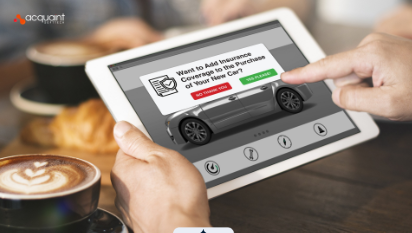
Why does a buyer who just spent an hour choosing a car still have to leave the showroom, call a broker, and wait days to insure it? That gap between buying the car and covering it is exactly where sales stall and customers drift.
As Head of Technology and Client Success at Acquaint Softtech, I have spent years building the API integrations and real-time transaction flows this depends on, so if you want to close that gap, you can start with our software product development services and bind coverage inside the purchase itself.
This article talks about how embedded auto insurance works at the point of car purchase, across dealer APIs, real-time underwriting, and instant binding, which is what you need before scoping a build. Because selling coverage at the point of sale touches distribution and licensing rules, it operates under the oversight of insurance regulators, coordinated in the United States. To see how this fits the wider InsurTech picture, our complete guide to InsurTech software development in 2026 gives the full context.
1. What Is Embedded Auto Insurance at Point of Sale
Embedded auto insurance lets a buyer secure and bind motor coverage directly through a dealership’s or carmaker’s checkout process. Using APIs, the dealer instantly syncs vehicle and driver details and returns bindable quotes in milliseconds, without the customer ever navigating away to a traditional third-party broker. Building that kind of real-time experience is where our AI development services and engineering come together.
The shift it represents is significant: motor cover moves from an afterthought handled days later to a core component of the digital vehicle purchase. The backend that holds this flow is often built by our hired Laravel developers, where the core runs on PHP. Delivering this end-to-end, from the checkout button to a bound policy, is what you get when you hire remote developers.
2. How the Integration Works
The architecture relies on modern APIs and SDKs to automate the whole journey. It starts with data prefill, where the dealer management system or carmaker checkout collects basic buyer and vehicle information, then pipes it into the rest of the flow without rekeying. The checkout interface that captures this is the kind of work our hire MERN stack developers deliver.
From prefill to bound policy
From there, the data flows through real-time underwriting, optional multi-carrier comparison, instant binding, and integrated payments, each step an API call rather than a manual handoff. The dealer-facing dashboards that manage this are built by our hired MEAN stack developers. This is a specific application of the embedded model, which we cover end to end in our guide to building an embedded insurance platform.
See also: How to Explore Work Options Before Making a Commitment
3. Real-Time Underwriting and Pricing
Once the data arrives, it is piped directly into automated carrier engines that analyze risk and compute premiums in under 200 milliseconds. Using persona models, these engines turn vehicle and driver details into a bindable price fast enough to feel instant in the checkout. The models behind this pricing are built by our AI and ML engineers.
Vehicle data makes the price sharper
Carmakers can feed vehicle-specific details, such as advanced driver-assistance systems or electric-vehicle safety profiles, into the rating logic to provide better, more competitive pricing than a generic quote. The real-time underwriting services that consume this are precise work for our hire Python developers.
Real-time pricing is one expression of automated underwriting, which we map in our guide to insurance underwriting platform development.
4. Instant Binding and Integrated Payments
Once the customer selects a policy, the API triggers an instant bind, issuing policy documents and finalizing coverage almost immediately, so the buyer drives off already insured. Making that happen reliably under real checkout traffic is the work of our hired DevOps engineers.
One payment, not three
The premium, and any localized subscription or finance cost, is then bundled directly into a single, seamless monthly billing or checkout flow rather than a separate invoice. The document generation and binding automation behind this are built by hire automation engineers. The billing and payments services that bundle it all together are built by our hired Django developers on the Python side.
5. Benefits for Dealers and Carmakers
The case for embedded auto insurance is concrete. Eliminating the friction of searching for an external policy lets buyers finalize the purchase without delay, and dealers and carmakers earn commissions or share in premium revenue, creating a valuable new layer of backend monetization. Deciding how to structure that program is a strategy question you can work through with our virtual CTO services.
Retention and personalization
Offering one bundled monthly payment for both the car and its coverage increases loyalty and convenience, while vehicle data lets carmakers personalize pricing in ways a generic broker cannot. Delivering a program of this scope is what our software development outsourcing teams take on. Owning the build with a focused, persistent team is what you get from our dedicated software development teams.
6. How to Build a Dealer-Embedded Insurance Platform
A build follows the flow: expose APIs and SDKs the dealer system can call, integrate with the dealer management system for prefill, connect to one or more carrier underwriting engines, add binding and document generation, and bundle payments. Each piece is a service the others call, so you can prove a single-carrier quote-and-bind before adding a marketplace. For a faster start on the surrounding product, you can build on our white-label software development.
Scope the integrations first
The hardest part is rarely the code; it is mapping how each dealer system and each carrier API actually behaves before you build against them. Getting that right at the start is exactly what our discovery workshop is built to do.
How the platform connects to policy, billing, and the rest of the core decides how much value it delivers, which we map in our guide to modern core insurance platform development.
7. Distribution, Partnerships, and Compliance
Embedded auto insurance succeeds or fails on partnerships: the dealer or carmaker owns the customer moment, and the program has to make selling coverage effortless for finance-and-insurance teams while sharing revenue fairly. Adding the engineering capacity to support a growing set of partners is what our IT staff augmentation is for.
Compliance built into the flow
Selling coverage at the point of sale carries licensing and disclosure obligations, so compliance has to be designed into the checkout rather than bolted on afterward. Most partners are not starting fresh either; they are adding this to a dealer system already in daily use, integrating through APIs without disruption, which is exactly what our version upgrade services handle.
Keeping carrier integrations, rates, and rules current as partners and products change is part of our support and maintenance services.
Coverage that lasts past the sale
The retention benefit only holds if the relationship continues after binding. An embedded program that stops at the sale leaves the customer to manage renewals, mid-term changes, and claims somewhere else, which quietly erases the loyalty the bundle was meant to create. The strongest programs route servicing and first notice of loss back through the same channel, so the dealer or carmaker stays present for the whole policy life, not just the first day.
That continuity is also where the data advantage compounds. Each renewal and claim adds to what the platform knows about the vehicle and driver, which sharpens pricing and makes the next offer more competitive. Designing for the full lifecycle from the start, rather than treating bind as the finish line, is the difference between a one-time commission and a durable book of business.
8. Cost by Region
Build cost depends on scope, and with embedded auto insurance, the API integrations and real-time underwriting usually dominate the budget. As a rough guide from our delivery work, a focused build, a single-carrier quote-and-bind integrated into one dealer system, commonly runs from about 80,000 to 200,000 US dollars, while a full multi-carrier marketplace with payments and SDKs runs higher. Sequencing that build is kept on track when you add one of our hired project managers.
Typical engineering rates by region
The same scope can cost very different amounts by region, which is the main reason platforms build with offshore partners. The dealer and buyer-facing portals that surround the flow are built when you hire WordPress developers.
| Region | Typical senior engineering rate | Relative build cost |
| United States | USD 100 to 200 / hour | Highest |
| United Kingdom | GBP 75 to 150 / hour | High |
| European Union | EUR 85 to 160 / hour | High |
| India (Acquaint Softtech) | INR 2,000 to 4,100 / hour (about USD 25 to 49) | Up to 40% lower |
These figures are estimates from our delivery practice and prevailing market ranges, not fixed quotes. The mobile experiences buyers use to manage coverage after purchase are built when you hire React Native developers.
9. Real Case Study: A Low-Friction Checkout Flow
Embedded auto insurance lives or dies on the checkout: a fast, reliable, low-friction flow that integrates cleanly with external systems and does not lose the customer at the last step. That is exactly the kind of work Acquaint Softtech delivered for Lampoo, an online luxury marketplace in Europe.
The engagement is a real, Clutch-verified project, and although it is fashion retail rather than auto insurance, it demonstrates that the discipline embedded in insurance depends on a rebuilt, step-by-step checkout that reduces drop-off and integrates with outside systems.
| Client | Lampoo (Founder and CEO, Enrico Trombini) |
| Industry and region | Online retail marketplace, Italy (EU) |
| Engagement | E-commerce platform rebuild with a redesigned, step-by-step checkout flow |
| What Acquaint built | Rebuilt checkout, product pages, seller dashboard, warehouse-system integration, backend cleanup |
| Outcome | Faster site, fewer dropped carts, high-traffic sales handled without slowing |
Acquaint Softtech rebuilt the checkout so it guided buyers step by step without confusion, connected the platform to an external warehouse system so data stayed correct, and hardened the backend to handle high traffic during major sales.
That same discipline, a clean checkout that holds up under load and integrates with outside systems, is precisely what an embedded quote-and-bind step needs at the point of car purchase. The e-commerce and checkout engineering behind it is the kind of work you get when you hire WooCommerce developers.
The way the team treated the platform like their own, flagging issues that were not even in scope and testing from both buyer and seller views, is simply how we operate. You can see how we work on our culture page.
10. Frequently Asked Questions
How does carmaker-embedded insurance work?
Carmaker-embedded insurance provides real-time insurance quotes during vehicle purchase. Customer and vehicle data are sent to an underwriting engine, which instantly prices, binds, and issues the policy.
Can I buy car insurance at the dealership?
Yes. Embedded auto insurance allows customers to get a quote and activate coverage directly at the dealership or during online vehicle checkout. The policy is issued immediately after purchase.
How do you embed auto insurance?
Auto insurance is embedded using APIs and SDKs that connect dealer systems with insurer underwriting platforms. This enables real-time quoting, policy selection, instant binding, and integrated payments.
How much does dealer integration cost to build?
| Solution Type | Estimated Cost |
| Single-Carrier Quote & Bind Platform | $80,000 – $200,000 |
| Multi-Carrier Embedded Insurance Marketplace | $200,000+ |
| India-Based Development Savings | Up to 40% lower than US, UK, and EU rates |
What is instant binding?
Instant binding activates insurance coverage immediately after the customer selects a policy. Policy documents are generated instantly, ensuring the vehicle is insured before delivery.
Why do dealers and carmakers offer embedded insurance?
Embedded insurance simplifies the buying process, increases revenue opportunities, and improves customer experience through a single, bundled purchase journey.
What technology does embedded auto insurance need?
Embedded auto insurance requires APIs, SDKs, real-time underwriting engines, policy issuance systems, payment integrations, and dealer management system connectivity. These technologies enable seamless quote-to-bind workflows.
